Head in the Stars
What does it take to become a novelist? For Hollin Hiller Bill Joseph, it meant eight long, difficult and sometimes heartbreaking years. But he’s just released his first novel, the science fiction thriller “AEONS” — and it’s a story as much about himself as it is about the galaxies.
By Stephen Brookes
October 2026
Who among us — and be honest, now — hasn’t dreamed of becoming a novelist? To conjure up riveting plots and beguiling characters, to bring beauty and wisdom to the world, to take your place in the pantheon of greats alongside Shakespeare, Tolstoy and Mickey Spillane? And of course there are the perks: the adoring reviews, the millions in royalties, the inevitable Pulitzer and the blockbuster starring Zendaya and Timothée Chalamet. All you have to do is sit down and write the thing — how hard could it possibly be?
In real life, of course, becoming a novelist may be one of the most grueling tasks you can set yourself. But one Hollin Hiller who turned the dream into reality is Bill Joseph, who in September released his debut novel AEONS — a sci-fi thriller that sprawls across the Milky Way and tackles nothing less than the fate of humanity itself.
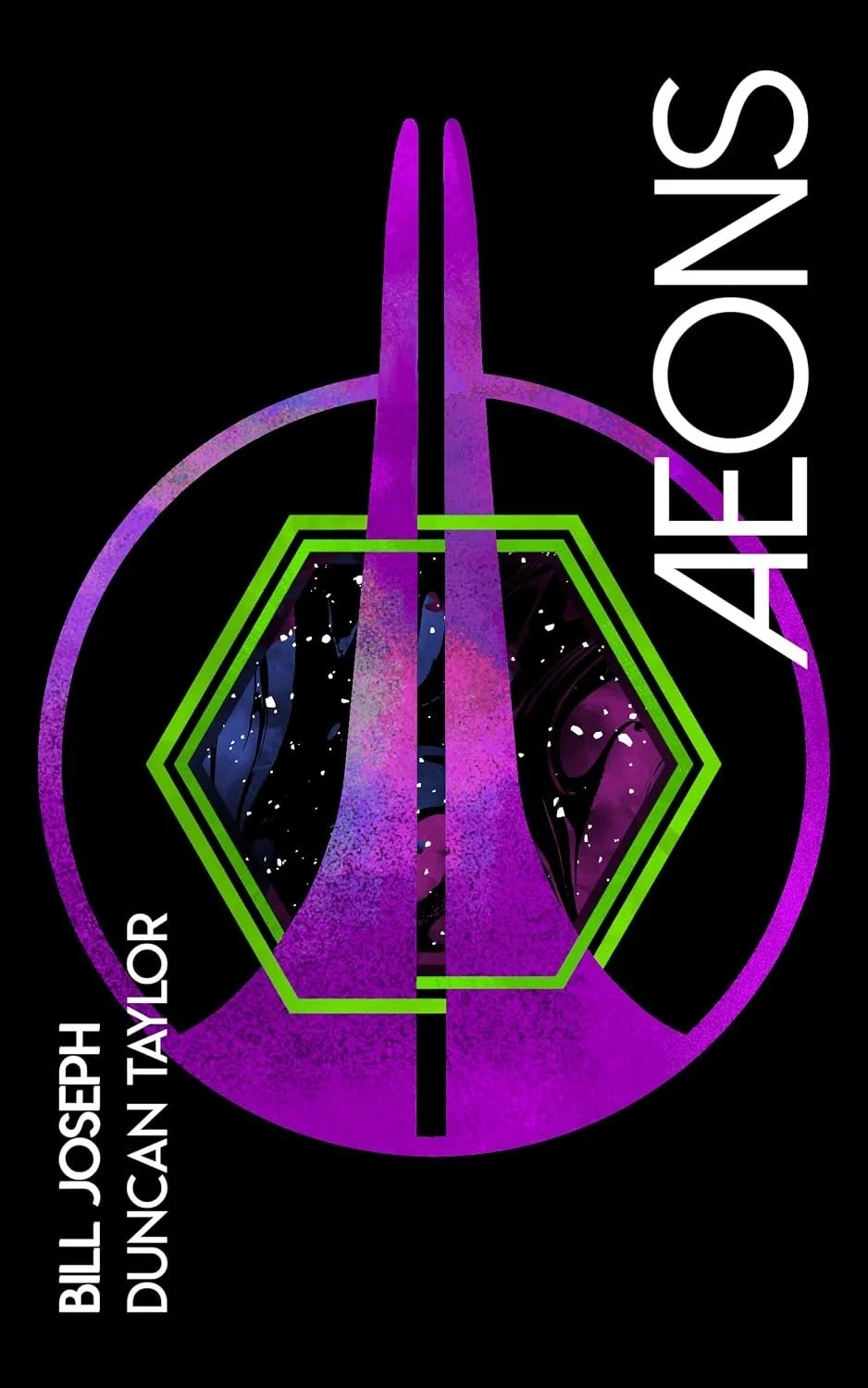
Bill Joseph and Duncan Taylor’s debut science fiction novel, AEONS, was released on September 1, 2026, and is available on Amazon.
Eight years in the making, and weighing in at a hefty 434 pages, AEONS is an epic by any definition — a freewheeling “space opera” that weaves together interstellar espionage, political intrigue, aliens of various shapes and colors, good old-fashioned romance — and a protagonist fighting his own crippling self-doubt as he battles a galactic terrorist conspiracy.
Colorful as it is, though, AEONS (an acronym for the “Agency for Extraterrestrial Observation and Surveillance”) is more than just science fiction, says Joseph, a 30-something attorney (and now novelist) who’s lived in Hollin Hills since 2020. Despite the exotic life-forms and occasional techno-speak (“perturbed leptons” make a memorable appearance), at its core the novel is a profoundly human story, driven by characters that most of us can relate to.
“It’s not, fundamentally, a story about aliens,” says Joseph, who co-authored the book with his longtime friend Duncan Taylor. “You could take this story out of an interstellar setting, put it in 2026 Earth and tell the same exact story, where people are trying to become more than they are — and where there’s always some subset of society saying, ‘no’.”
Which is, in a very real sense, the story of the author himself.
“I was telling stories before I even knew how to write,” says Joseph, on a cool October afternoon in the open, light-filled home he shares with his husband Michael and their young son. An animated speaker who never seems at a loss for words, Joseph grew up on a steady diet of Star Trek, which nourished both a love of science fiction and the sense that it was more than just entertainment — that it could address serious ethical and human questions.
“Jean-Luc Picard was my secondary father figure,” he says, of the philosopher-commander of the Starship Enterprise. “Everything I learned about morality came from him.”

So at sixteen, Joseph decided to try his hand at fanfiction. He launched an online role-playing game (or RPG) where a group of players on a message board each create a character in the Star Trek universe, and contribute to an unscripted, free-flowing story. It was his first attempt at fiction — and he found it frustrating.
“I wanted things to happen a specific way,” he says, “and if a player went in a direction I didn’t like, I would send them a message: ‘Hey, why don't you do this, instead?’ That should have been a clue,” he adds with a laugh, “that an RPG wasn't the right vehicle for the story I wanted to tell.”
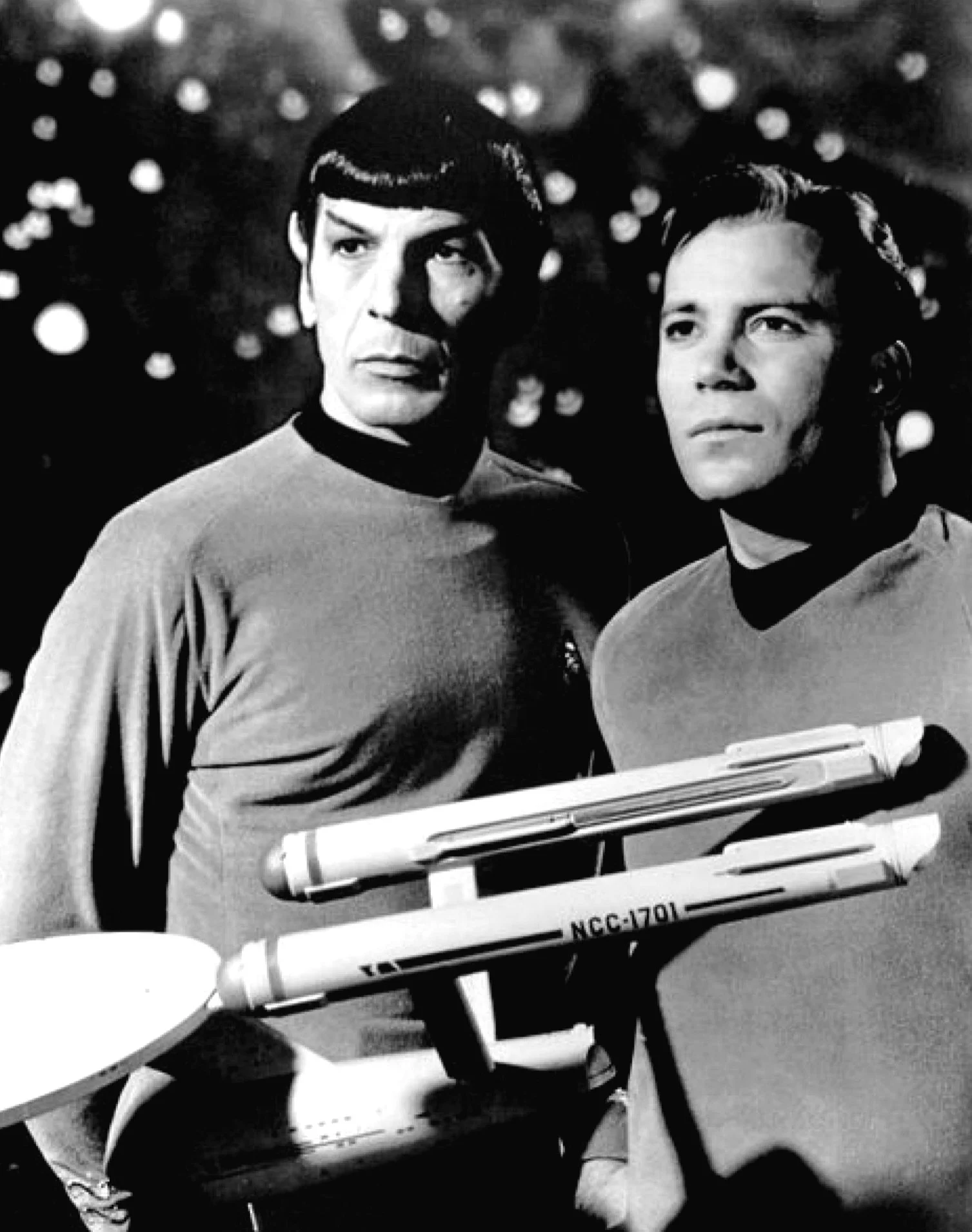
Joseph kept the message boards going through college and law school, creating five full “seasons” of Star Trek stories. He looked into publishing them but came up against intellectual property concerns, so in 2018 he approached Duncan Taylor, a longtime collaborator in the RPGs, and proposed that they leave fanfiction behind — and write a new, entirely original novel.
Star Trek’s complex stories and characters were an early influence on Bill Joseph; the profound moralism of Jean-Luc Picard (below) left a particularly strong mark.
It was a turning point in his life. Joseph was establishing a career in law, but his ambition to be a published author — not just an attorney with a writing hobby — was growing, and he and Taylor began tossing book ideas back and forth online. (Taylor lives in Australia, and the two have only met in person once, in over twenty years of friendship.) As a plot began to take shape, they found themselves bringing complementary strengths to the writing, with Joseph focused on character development and Taylor more on technology. But it was far from easy; the creative partnership resulted in better work, he says, but at a price.
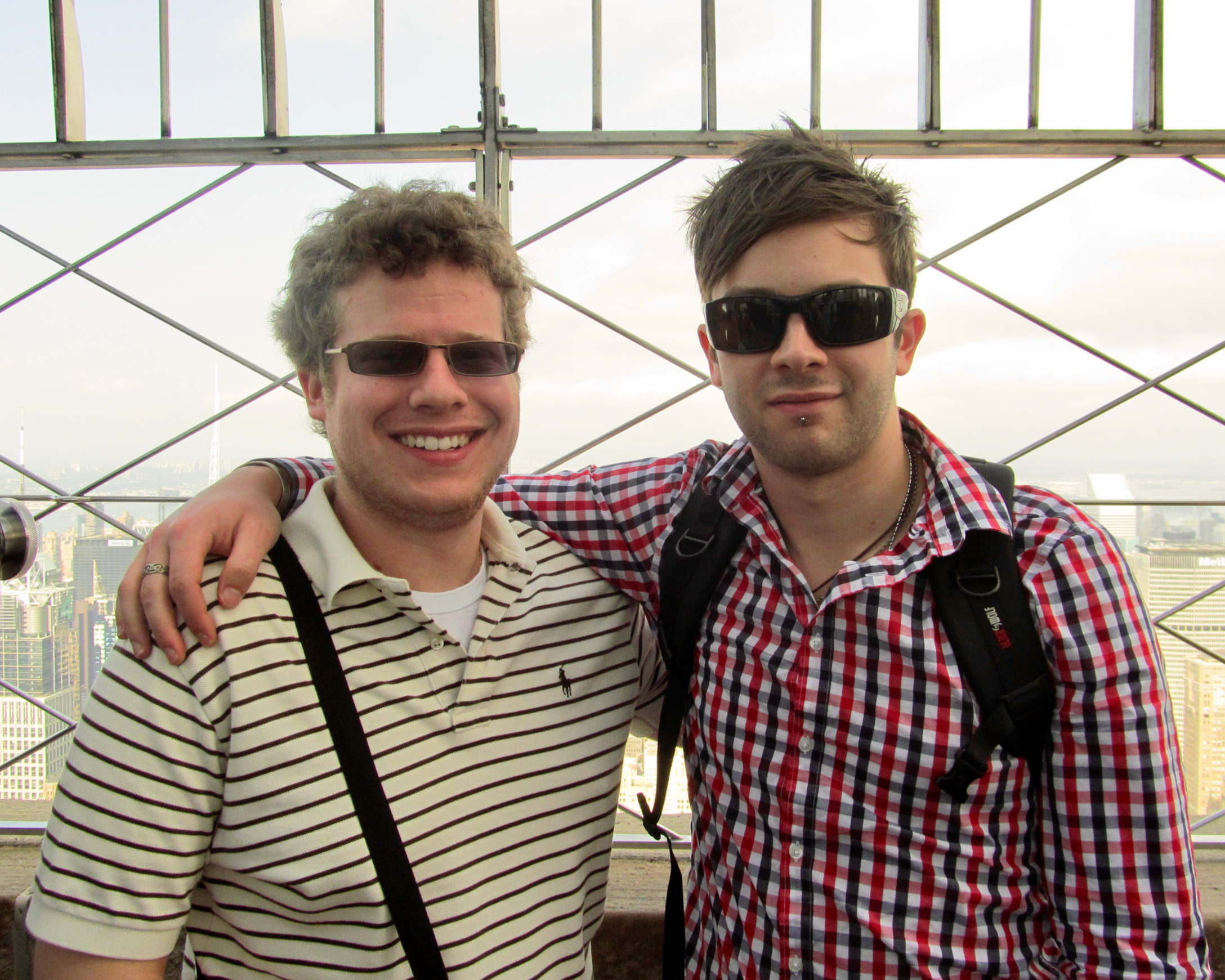
Joseph (left) and co-author Duncan Taylor, during their one non-online meeting in 2012
“It was a tug-of-war of ideas,” Joseph says, of the three years that it took to complete the initial draft. Challenging each other at every turn, they slowly fine-tuned the story but often got stuck for weeks at a stretch. “There were a lot of times,” he says, “when the engine just stalled.”
Nevertheless, they persisted — and a complex, richly-imagined story emerged. The plot is dramatic (“intelligence agents must stop a group of xenophobic humans from derailing our membership in an interstellar Republic,” is Joseph’s elevator pitch) and the other-world settings are vivid. But there’s a subtler, more nuanced story unfolding in the minds of the characters themselves.
“I wanted to write a character-based story,” says Joseph, “because I’ve always thought that the best sci-fi is a mirror. It should be something that makes you look at yourself — and I want people to see themselves in the characters.”
“The big question that we ask in this story is: What do we deserve?”
Nowhere is that “mirror” more reflective than in Boyd Firedrake, the protagonist of the story. Tasked with saving mankind, he’s not an obvious choice for the job — despite his self-assured name, Firedrake has so little self-confidence that he can barely make it from one minute to the next. With a relentless voice in his head telling him he’s doomed to fail, unable to believe that others might genuinely believe in him, Firedrake must find the strength and resilience not only to vanquish intergalactic terrorists, but to master his own mind, as well.
So … does that make the fictional Firedrake a sort of proxy for Joseph himself: a young, untested writer who must prove himself on the battlefield of publishing?
“Well ... all art is invariably self-portrait!” says Joseph, who, for all his outgoing confidence, admits to a sense of imposter syndrome when it comes to writing.
“The big question that we ask in this story is: What do we deserve?” he says. “We all have that voice in our heads that tells us we are not good enough. We are not smart enough. We don't deserve good things. And you have to overcome your own self-doubt to go on and accomplish something — and maybe redeem yourself.”
Joseph and Taylor finished a first draft, then ran it by two groups of “beta” readers (who give feedback on where they were engaged, or confused, or just wandered off) and a developmental editor for advice. They re-wrote large sections and trimmed the book by a whopping 25,000 words — a process that took another three full years — before they were ready for the final, biggest hurdle of all: getting the novel published.
From the beginning, Joseph’s dream was to have AEONS released by one of the “Big Five” houses, such as Simon & Schuster or Penguin Random House. The imprimatur of a major publisher gives any new book credibility, not to mention publicity, distribution and top-level editing. It’s a direct line to getting your work into bookstores and libraries, and maybe selling the film rights. And for Joseph, it meant validation as a genuine novelist.
Publishers rarely take manuscripts directly, so Joseph needed a literary agent to get AEONS in the door — but with tens of thousands of manuscripts out there, and only a relative handful of agents who accept science fiction, finding one soon became an exhausting and discouraging grind.
“I spent a year querying literary agents,” he says. ”And just finding the right ones to query was difficult, because they all have very specific genres. There are agents who take sci-fi but not space opera, and there are agents who take space opera, but not if it has espionage characters. And when you finally find an agent to query, you have to look at their ‘wish list’ and tailor your application for each one — and they all have different guidelines.”
Joseph spent hours every day writing to agents, sending out dozens and dozens of queries over the course of the year. And the response was basically … crickets.
“I queried 153 literary agents,” he says, “and I got 153 rejections. I didn't even get a single request to see the manuscript.”
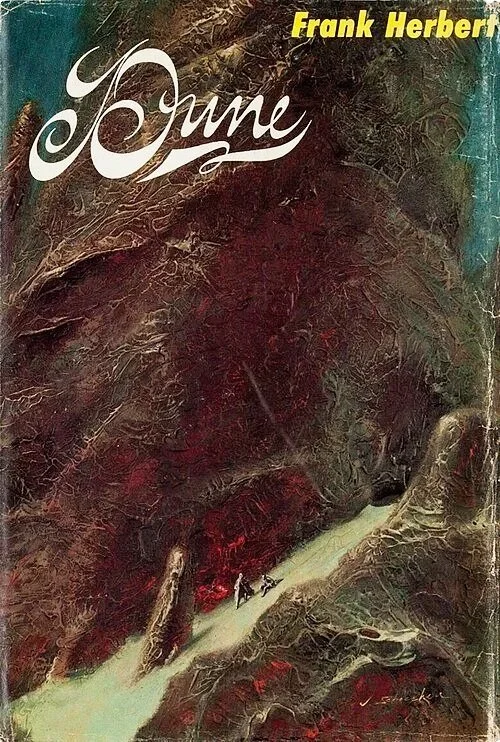
Getting a novel into print is rarely easy. One of the best-selling science fiction books of all time — Frank Herbert’s 1965 “Dune” — was rejected by twenty publishers before it was accepted by Chilton, a company best known for car-repair manuals.
The rejection was crushing — “the world will always break your heart,” he says, a bit ruefully — but hitting a dead end with agents forced him to find another way forward.
And as he and Taylor quickly discovered, they didn’t really need an agent at all. Over the past decade, self-publishing has revolutionized the industry, and traditional agents and publishers no longer control access to readers. Driven by Amazon, whose Kindle Direct Publishing system lets writers sell directly to their audience (either as an ebook or a physical book that’s printed on demand), self-publishing is skyrocketing — and with more than ten times as many new self-published titles in 2025 than there were from traditional publishers, it seems to be the wave of the future.
Publishing AEONS themselves, Joseph realized, would also give them some real advantages. He and Taylor would retain complete editorial and artistic control, decide when to publish and how much to charge, and of course keep more of the royalties. Marketing their book remained a challenge, but while a traditional publisher might launch a big promotional campaign for them, it also … might not.
So Joseph hired an artist to design the cover, formatted the text — and on September 1, released AEONS on Amazon. It’s not quite a runaway sensation yet (Joseph says that, as of mid October, they’ve sold a total of 98 copies), but it’s garnering admiring five-star reviews from readers who call it “a compelling read” and say it has “enough plot twists to keep Agatha Christie’s head spinning.”
Bill Joseph opens his first printed copies of his novel AEONS
And while it would have been gratifying to write an international best-seller, Joseph says, just bringing the novel into existence and getting it out to an appreciative audience has given him a deeper understanding of what it means to be a successful author.
“You have to give yourself the grace of, it's ok if I don't sell a million copies of this book,” he says. “Because the people who matter to me are reading it, and the people who matter, like it. That anybody would read the book is an honor to me,” he adds, with a smile. “I’ve sold 98 copies, which is 98 more than I thought I would!”
In fact, if Joseph has been discouraged even slightly by the writing life, it doesn’t show — he and Taylor are now working on a sequel, and plan to make AEONS the first book of a trilogy. They’re busily sketching out narrative threads and dreaming up plot twists — a process that he says he looks forward to, despite the inevitable challenges, setbacks, and heartaches involved.
“I don't know who I am without this,” he says. “If the alternative was letting AEONS wither and die on the vine, I don't think I could have lived with that. This story is a part of who I am, because this is what I've always wanted to do. This is who I've always wanted to be.”
— Stephen Brookes, October 2026